
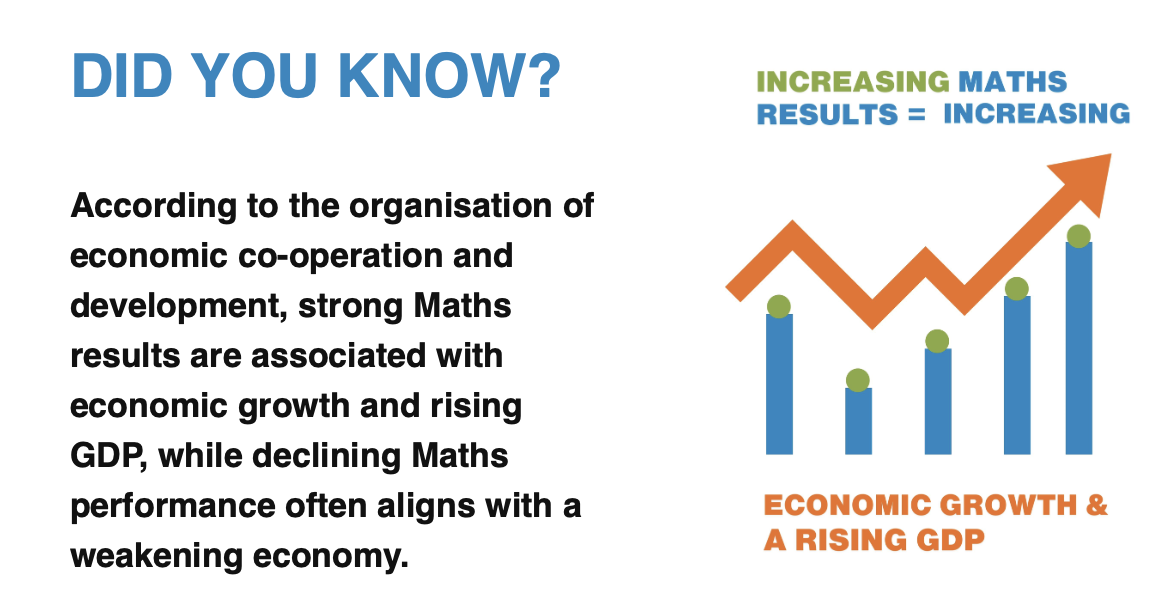

The Organisation for Economic Co-operation and Development found that Maths performance is directly linked to a nation’s economic well-being, reflected in its GDP (Gross Domestic Product). Their research shows a clear pattern: countries with declining Maths results tend to experience declining economic growth, while those with strong Maths performance see their economies strengthen and their GDP grow.
This is not just a national issue it plays out inside businesses every day. People-related challenges are among the most expensive hidden cost drivers in any organisation. Though not always visible on a balance sheet, global benchmarks indicate that personnel inefficiencies can increase operating costs by approximately 15% to 40% plus, depending on severity. In South Africa, these pressures are further intensified by external factors such as inflation, infrastructure challenges, municipal service delivery issues, and crime adding an estimated 15% to 30% annually to operating costs, depending on the industry.
At the core of many of these challenges lies a critical gap: a lack of strong problem-solving and critical thinking skills within the workforce. This is where Mathematics plays a foundational role. Mathematics is not just about formulas or complex calculations. While only a small percentage of careers require advanced mathematical application (such as engineering, science, and technical fields), the true value of Maths lies in the cognitive skills it develops from an early age.
Three key truths often overlooked:
- Mathematics builds critical thinking and problem-solving abilities.
- These abilities are essential for success in any profession and in life.
- Mathematics is the primary subject that consistently develops these skills throughout a learner’s education.
When these skills are underdeveloped, the impact is felt across an organisation:
- Low ownership and accountability
- Reactive rather than proactive behaviour
- Poor decision-making
- Increased reliance on management intervention
- Slower productivity and unresolved problems
On the other hand:
- Critical thinking drives responsibility and ownership
- Problem-solving builds initiative and forward-thinking behaviour
- Strong cognitive skills translate into better work ethic, efficiency, and performance
Work ethic, therefore, is not just attitude it is a skill-based behaviour shaped over time. These skills are built consistently during a child’s school years, with Mathematics being the number one contributor. This is why improving Maths understanding is not just an education priority it is an economic and business imperative.
My Maths Buddy exists to address this at its root:
- Helping learners truly understand and apply Mathematics
- Equipping teachers with the tools to teach for deep understanding
- Building a generation capable of thinking critically, solving problems, and contributing meaningfully to the economy
Stronger Maths understanding today leads to stronger businesses, stronger economies, and a more sustainable future.

We need you to join us in our crusade to uplift standards of Maths education in South Africa. Every child you decide to sponsor will be given a chance to improve their Maths understanding and performance thus opening a door to better possibilities and higher abilities to not only survive well for themselves but also contribute positively to their society.
Every teacher you decide to sponsor will get trained on how to teach Maths with full understanding and how to bring love for Maths.
You can either choose a school in your community like many of our sponsors do or support one of the schools that we already working with.
Apart from being part of the positive movement that changes children lives you also will be able to receive tax and BEE benefits that your company is entitle to when donating towards our campaign.
Click on the below links to learn how you can participate.

